
The Nafs Al-Ammara, The Self That Keeps Commanding You Toward What Harms You
If you have ever asked yourself why you keep doing what you do not want to do, this post is for you. The Islamic understanding of the nafs al-ammara is one of the most practically useful pieces of knowledge a Muslim woman can have. And nobody told us about it.
Umm Sumaya
5/25/20269 min read


You made the intention. Again. This time it was going to be different.
And then, without quite knowing how it happened, you were back in the same place. The same pattern. The same food. The same guilt. The same quiet voice asking: why do I keep doing this?
If that question lives somewhere in your chest, this post is for you.
Because the answer is not what most of the wellness space tells you. It is not a lack of discipline. It is not a motivation problem. It is not something broken inside you that needs fixing with another plan, another reset, another fresh start on Monday.
In Islam, there is a profound, precise, and deeply compassionate framework for understanding exactly why we keep returning to what harms us. It is not a modern psychological concept. It is Quranic. It is part of the deen. And it has a name.
It is called the nafs al-ammara.
Understanding it will not instantly change your patterns. But it will change how you see them, and that is where every real change begins.
What Is the Nafs, And Why Does It Matter?


The nafs is mentioned over 300 times in the Quran. It is not a peripheral concept. It is central to the Islamic understanding of the human being, who we are, how we act, and why we do what we do.
The nafs, in its most direct translation, means the self. But it is far more than that. It is the seat of your desires, your instincts, your emotional responses, and your spiritual state. It is the inner dimension of the human being that the Quran addresses directly, repeatedly, and with extraordinary depth.
Ibn al-Qayyim al-Jawziyyah, one of the greatest scholars of the heart and the nafs, wrote extensively on its states, its diseases, and its purification. His work makes clear that understanding the nafs is not a self-help exercise. It is an act of worship. It is part of knowing yourself as Allah created you.
"By the soul and He who proportioned it." — Quran 91:7
Allah swears by the nafs. That alone tells us its weight and significance in the deen.
The scholars describe three primary states of the nafs. Understanding these three states is one of the most practically useful pieces of Islamic knowledge a Muslim woman can have — because once you can identify which state is operating in a given moment, you are no longer at its mercy.
The Three States of the Nafs
The Quran describes the nafs in three distinct states. Each one represents a different relationship between the self, the heart, and Allah.
1. Nafs Al-Ammara, The Commanding Self
This is the lowest state of the nafs. The word ammara comes from the Arabic root meaning to command, to order, to insist. The nafs al-ammara commands toward what feels immediately good, comfort, ease, pleasure, avoidance, with no regard for consequence, intention, or the wellbeing of the heart.


"Indeed, the soul is a persistent enjoiner of evil." — Quran 12:53
This is the nafs in its default, untamed state. It does not reflect. It does not weigh options. It simply commands. And without awareness, without the work of taming it, it runs the show.
2. Nafs Al-Lawwama, The Self-Reproaching Self
This is the nafs that knows better and still falls, and then blames itself for falling. The word lawwama comes from the root meaning to blame, to reproach. This is the nafs that produces guilt, the nafs that knows the pattern is harmful and yet keeps repeating it.
If you are reading this and recognising yourself, you are likely in the lawwama. That is not a condemnation. It is actually a sign of spiritual awareness, because the nafs al-lawwama still has a conscience. It still responds to what is right. It is in the struggle, not past it.
3. Nafs Al-Mutmainna, The Soul at Peace
This is the destination. The nafs al-mutmainna is the soul that has returned to Allah, not just in action, but in its very state. It is no longer at war with itself. It has found stillness in the remembrance of Allah, in submission, in sincerity.
"O reassured soul, return to your Lord, well-pleased and pleasing to Him." — Quran 89:27-28
This is what we are working toward. Not perfection. Not flawless habits. The nafs at rest in Allah.
Do you recognise which nafs is leading your life right now?
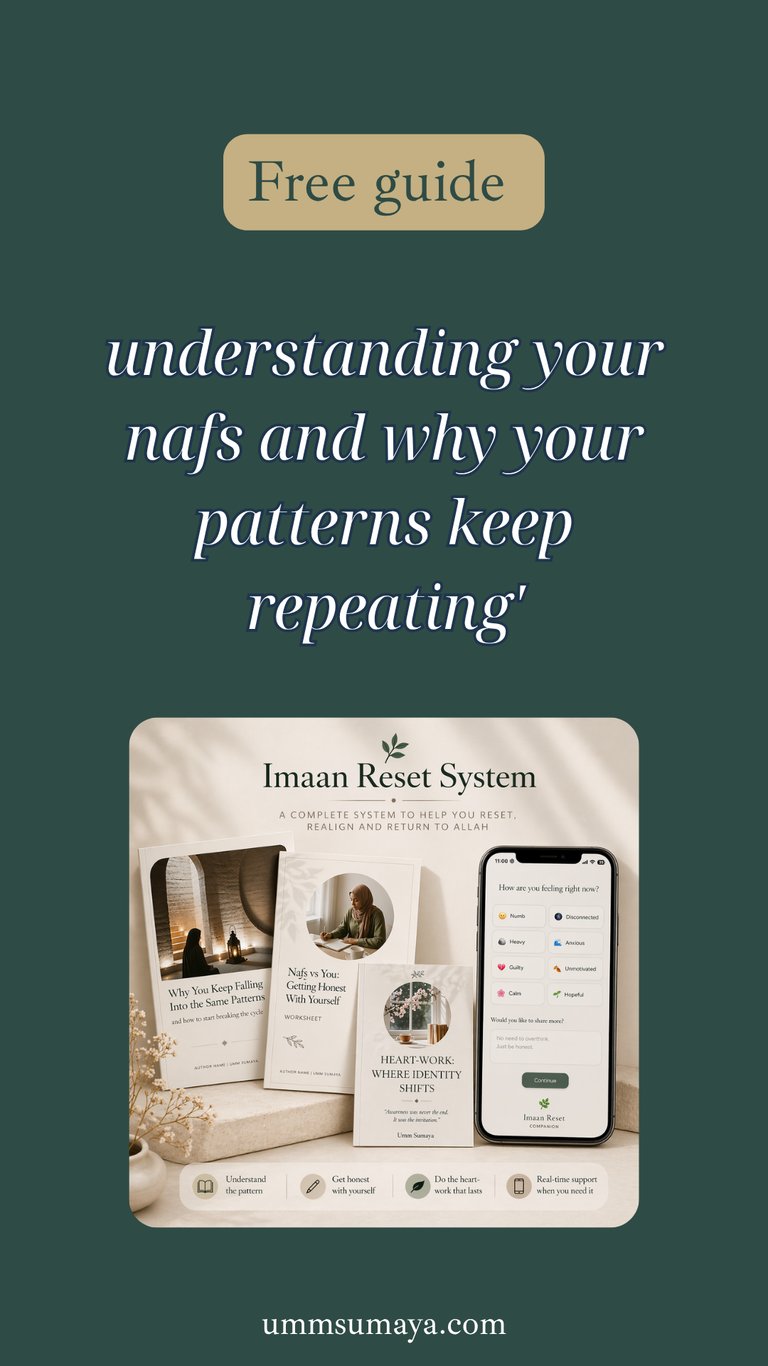
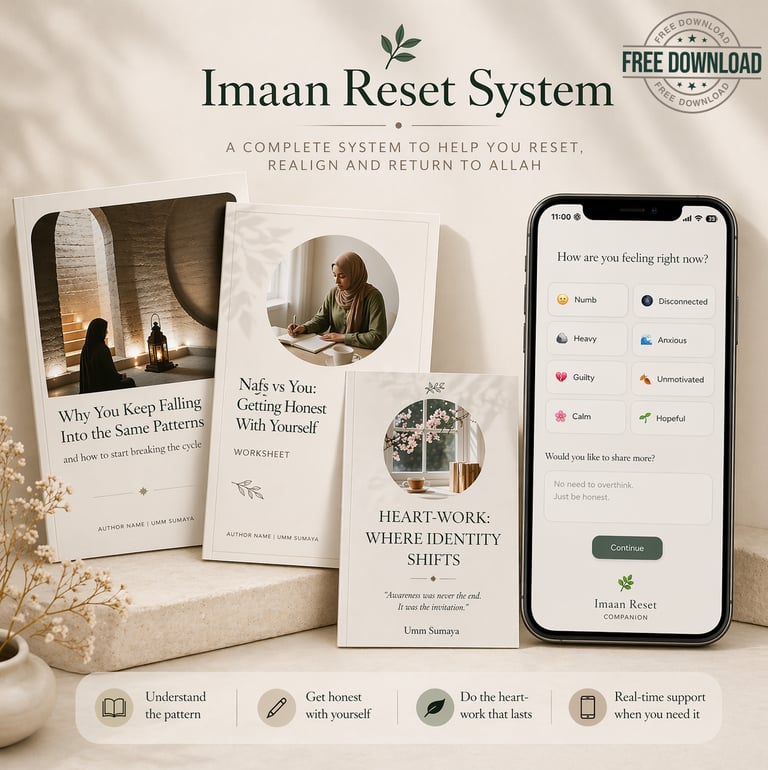
The Imaan Reset System is a free guide designed to help you understand the nafs, identify your emotional patterns, and begin the return to conscious choice, rooted entirely in the deen.
If you are reading this and feeling the recognition, this guide was written for you.
How the Nafs Al-Ammara Operates in Daily Life
The nafs al-ammara is not dramatic. It does not announce itself. It operates through familiar, reasonable-sounding thoughts that feel like your own voice. This is what makes it so difficult to identify, and why awareness is the essential first step.


Here is what the nafs al-ammara sounds like in practice:
'I'll start properly on Monday.' — The nafs buying time. Every delay is the nafs al-ammara protecting its hold.
'Just this once won't matter.' — The nafs negotiating with your niyyah. It is almost never just once.
'I've already slipped, I may as well continue.' — The nafs closing the door on immediate return. This is one of its most effective strategies.
'I'm too tired / stressed / emotional to do this right now.' — The nafs using real feelings to justify avoidance. The feelings may be genuine. The conclusion the nafs draws from them is not.
'I deserve this.' — The nafs disguising desire as self-compassion. True self-compassion nourishes the heart. This soothes it temporarily and harms it over time.
'Nobody understands how hard this is.' — The nafs using isolation to avoid accountability and return.
None of these thoughts feel like the nafs speaking. They feel like you speaking. That is precisely the point. The nafs al-ammara is most powerful when it is invisible, when its voice is indistinguishable from your own.
The moment you begin to recognise the nafs al-ammara in your thoughts, to catch it mid-sentence, to name it, something shifts. You are no longer inside the pattern. You are watching it. And from that position, choice becomes possible.
This is what the scholars called muraqabah, the consciousness of being observed by Allah, combined with self-observation. It is not self-criticism. It is self-awareness in the presence of Allah. And it is transformative.
The Nafs Al-Ammara and Emotional Eating
For many Muslim women over 40, the nafs al-ammara has a very specific and well-worn path: toward food.
Not because they are weak. Not because they lack discipline. But because the nafs al-ammara seeks soothing, and food, over years and decades, has become its most reliable source of immediate relief.
The emotional eating episode follows a pattern that is almost identical every time:
A feeling arises — overwhelm, loneliness, guilt, boredom, frustration, exhaustion.
The nafs al-ammara recognises the feeling and immediately moves toward its learned comfort.
The movement toward food happens before conscious thought catches up.
Temporary relief. The feeling is numbed, not resolved.
Guilt follows. And for many sisters, the guilt itself becomes the next trigger.
The intention is renewed. Until the next time.
This is not a food problem. It is a nafs problem. The food is simply where the nafs al-ammara has learned to go. Which means that no nutritional strategy, no meal plan, and no amount of willpower will address what is actually happening, because they are all working at the level of the behaviour. The work of the nafs has to happen at the level of the source.
This is not to say that what you eat does not matter, the body is an amanah and nourishing it wisely is an act of worship. But lasting change in your relationship with food begins not on your plate. It begins in your understanding of what is commanding you toward it.
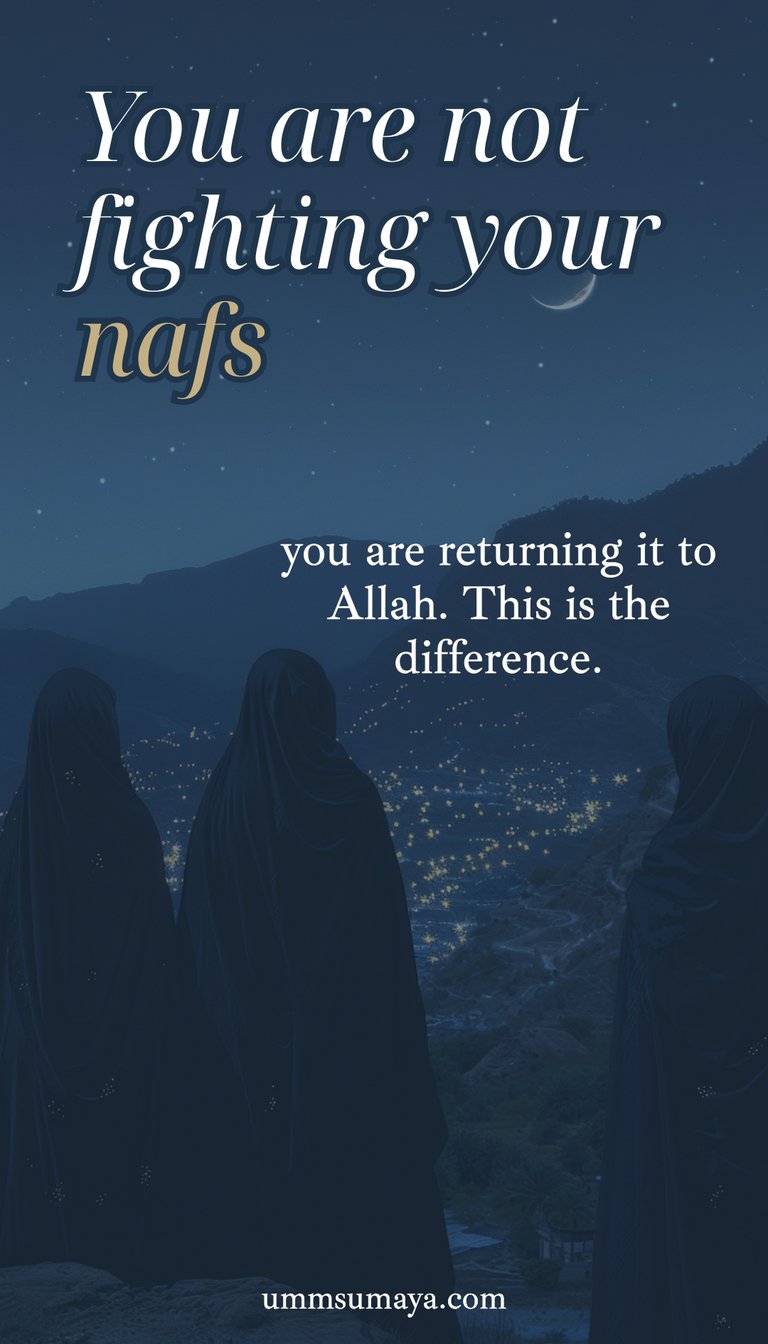
This Is Not About Fighting Yourself, It Is About Returning.
Here is perhaps the most important thing in this entire post, and it is something the wellness world will never tell you:
You are not supposed to destroy your nafs. You are supposed to purify it.
"Successful is the one who purifies it." — Quran 91:9
The work is not war. It is return. Gradually, patiently, with the tools the deen has given us, the nafs al-ammara can be educated, disciplined, and moved toward its higher states. This is the greater jihad the Prophet ﷺ spoke of, and it is a lifetime's work, not a weekend reset.
Where do you begin? Not with a dramatic overhaul. With three small, consistent acts rooted in the deen:
Muraqabah — begin to notice. When you feel the pull toward a familiar pattern, pause for one moment and name what is happening. 'This is my nafs al-ammara.' You do not have to do anything else in that moment. Awareness alone interrupts the automatic.
Istighfar — after every slip, return immediately. Not tomorrow. Not after the guilt has run its course. Now. The door of tawbah does not close. The nafs al-ammara wants you to believe it does — that you have gone too far, fallen too many times, waited too long. This is a lie. Return anyway.
Dhikr in the difficult moment — when the nafs commands and the feeling is strong, bring in the remembrance of Allah. Subhanallah. Alhamdulillah. La ilaha illallah. This is not a distraction technique. Dhikr softens the heart and loosens the grip of the nafs over time. Ibn al-Qayyim wrote at length on this — the heart that remembers Allah is not easily commanded by the nafs al-ammara.
None of this is linear. You will notice and still give in. You will make istighfar and slip again. You will remember Allah and still find the nafs winning the moment. This is not failure. This is the nafs al-lawwama, the self that knows and still struggles. And the nafs al-lawwama is closer to return than she realises.
The sister who keeps coming back, who keeps making the intention, who keeps feeling the guilt, who keeps reading posts like this one looking for a way through, she has not failed. Her nafs al-lawwama is alive and working. That is not defeat. That is the path.
Ready to understand your patterns at a deeper level?
The Imaan Reset System is a free guide that walks you through the nafs, your emotional patterns, and the first steps toward conscious return, in Islamic language, for Muslim women who are tired of starting over.
Download it free and begin where you are.
Click the link: Imaan Reset System
A Final Word, For the Sister Who Is Tired of Starting Over
If you have read this far, something in this resonated with you. Perhaps you recognised your own thoughts in the list of things the nafs al-ammara says. Perhaps the framework of the three states gave language to something you have been living but could not name.
You are not broken. You are not uniquely weak. You are a Muslim woman navigating the struggle that every human being was created to face, the struggle with the nafs. And the fact that you are still in it, still seeking, still returning, that matters more than you know.
Allah does not ask for perfection. He asks for sincerity and return. And every single time you choose awareness over automatic, every single time you make istighfar and come back, you are doing the work. Even when it does not feel like it.
'You are not fighting your nafs to destroy it. You are training and nurturing it, so it can work for you, causing you to return to Allah. That is the work. And it is worth doing.'
- And Allah knows best
The Imaan Reset System — Free Download
A free guide for Muslim women over 40 who want to understand the nafs, recognise their emotional patterns, and begin the return to conscious choice and barakah.
If this post spoke to you, the guide will take you deeper. It is completely free and waiting for you.
Asalam Alaykum, I'm Umm Sumaya
I helps Muslim women over 40 understand the role of the nafs in emotional eating, self-sabotage, and the patterns that keep them stuck, so they can return to conscious choice, restore barakah, and reconnect with Allah. My work draws on Islamic psychology, lived experience, and a deep understanding of the challenges facing Muslim women in midlife.