
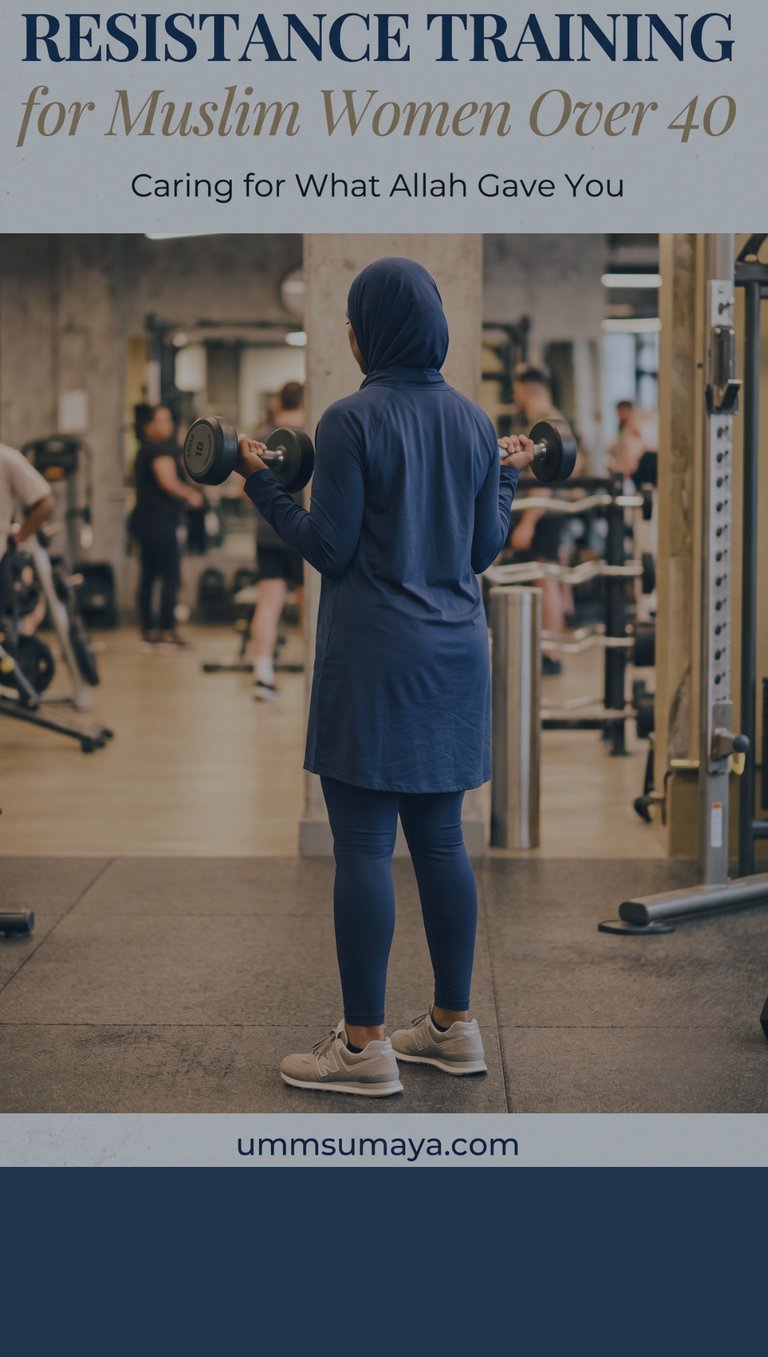
Resistance Training for Muslim Women Over 40, Caring for What Allah Gave You
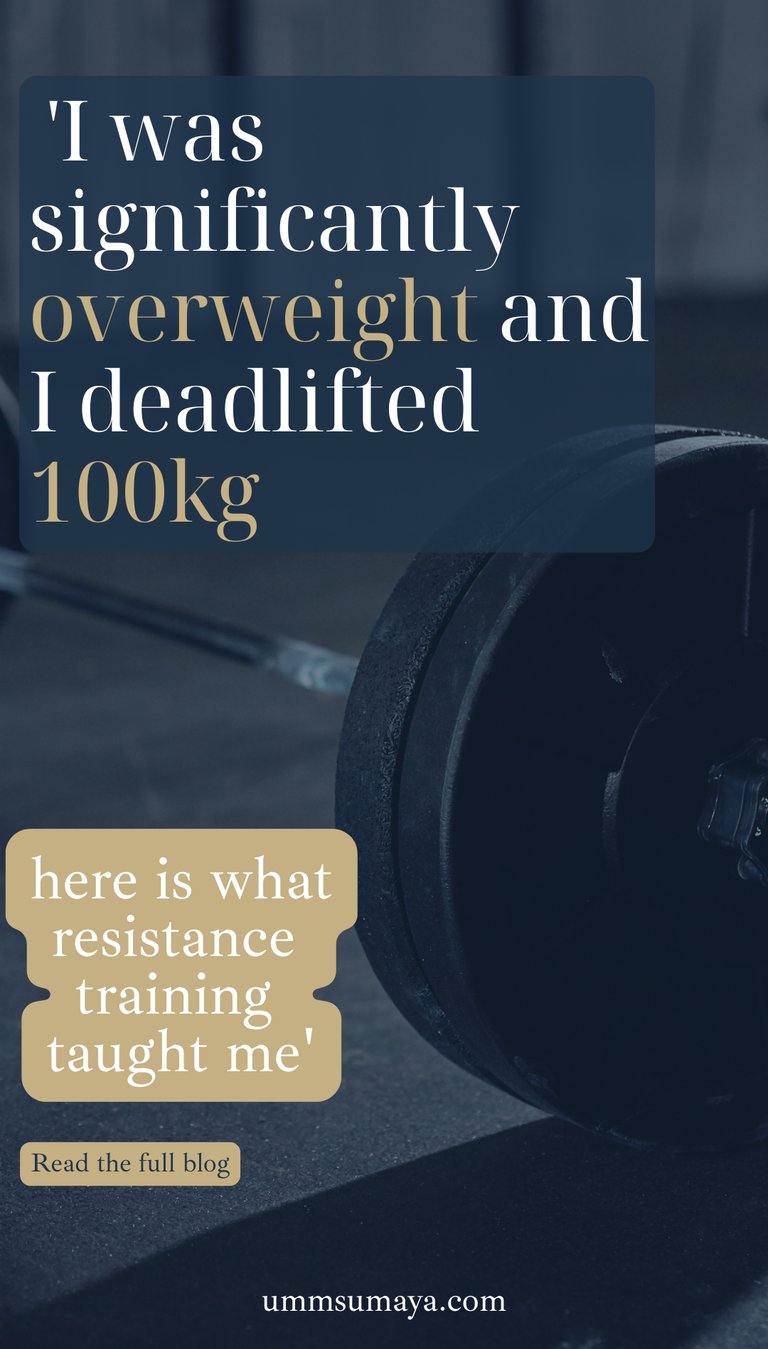
I am a Muslim woman over 40. I have been significantly overweight for most of my life. And I worked up to deadlifting a hundred kilograms. Not because I am exceptional, but because this body, any body, responds to being cared for. Here is what resistance training taught me and how you can begin where you are.
Umm Sumaya
7/9/202611 min read
I want to be honest with you from the start about who this post is for.
It is not for the sister who is a few pounds away from where she wants to be. It is not for the sister who is already active and looking to optimise her routine.
This post is for the sister who is significantly overweight and has been for most of her life. The sister who has tried and stopped and started again more times than she can count.
The sister whose body is beginning to show the strain of years of carrying extra weight, the aches, the fatigue, the joints that protest in ways they did not before. The sister who has an unhealthy relationship with food and knows it, but has felt so helpless in the grip of it that she has started to believe this is simply who she is.
I am writing for her because I am her. Or I was. And I want her to know, before she reads another word, that she is not broken, she is not hopeless, and she is not too far gone. She has simply been allowing her nafs to lead in an area where she needs to take back the reins.
And resistance training, of all things, is one of the places where that begins.
Here is something that might surprise you. Exercise has never really been my barrier.
Even as a child, even as an overweight teenager, I was active. I was on the netball team. I did track and field. I danced and performed. The weight was always there but so was the movement. They coexisted in a way that confused me for years because I could not understand why being active made so little difference to my body.
The answer, which I only came to understand much later, was the food. But more on that in another post.
When I started resistance training at the end of 2022, I was in my early forties and I had spent most of my life doing cardio. Running, walking, aerobics, that was my understanding of exercise. Strength training felt like something that belonged to other people. Younger people. People who already knew what they were doing in a gym.
What changed my mind was information. I started watching content online that explained how resistance training builds and preserves muscle mass, increases metabolic rate, helps with body recomposition, and supports the kind of sustainable fat loss that cardio alone does not produce. I was convinced by the evidence. So I decided to try it.
What I did not expect was to deadlift a hundred kilograms. But I did. And it was one of the most empowering experiences of my life.
Not because of the number. But because of what it told me about what this body, the one I had spent decades at war with, was actually capable of.
I Was Not the Sister Who Needed Convincing About Exercise
How I Actually Started, For the Sister Who Does Not Know Where to Begin
I want to tell you exactly how I started because I think the practical reality of beginning is what most fitness content skips over entirely.
I had never really used a gym before in the way I was about to. I did not know the machines. I did not know the etiquette. I did not know where to stand or what to pick up or how much weight to use. And I am not going to pretend that walking into a gym for the first time as a Muslim woman, modestly dressed, significantly overweight, with no idea what I was doing, was entirely comfortable.
But here is what I did.
The first couple of times I went, I did not train. I just went. I walked in, I got on the treadmill, and I looked around. I watched what other women were doing with the dumbbells. I took photographs of the machines. I went home and I Googled every single one of them. I downloaded an app called EvolveU that gave me a structured workout plan I could follow. And then I went back with three things I did not have before: a layout I recognised, an understanding of the equipment, and a plan.
That is it. That is how it started.
I also want to say something about the modesty question because I know it is on the minds of many sisters. I looked for gyms with women-only sections and found them. But I have also trained in mixed gyms. And what I discovered very quickly is that the anxiety about being seen or judged is largely self-generated. When you look around a gym, you will find that almost every person there is looking in the mirror at themselves. They are monitoring their own form, their own progress, their own physique. Nobody is looking at you. And once that sinks in, it becomes much easier to focus on what you came to do.
Wear what covers you. Make your intention. And begin.
Before you start moving, it helps to understand what has been keeping you still.
The Imaan Reset System is a free guide for Muslim women over 40 who want to understand the role of the nafs in the patterns that have kept them stuck, including the pattern of starting and stopping with their health. It is grounded in the deen and completely free.
Download The Imaan Rest System it before you read on.
When the Deen Connection Came, And Why It Changed Everything
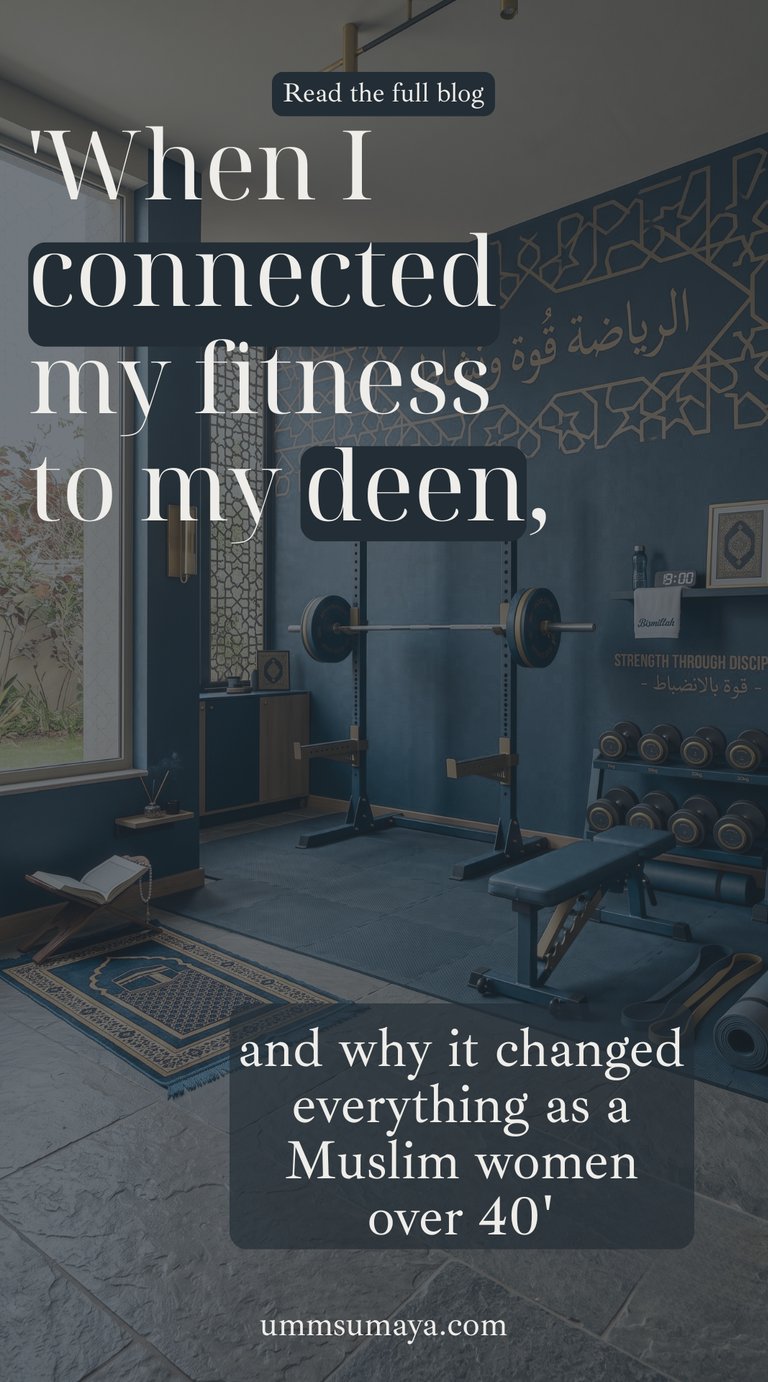
I want to be honest here too. When I first started resistance training, it was not connected to my deen. I was exercising to lose weight, to improve my metabolism, to reshape my body. The intention was health and fitness. Islam was not part of the frame yet.
The connection came later. Gradually. As I started taking my deen more seriously, as I began learning about the nafs and understanding the role it had played in my relationship with food, as I started to see clearly how the nafs had hijacked what should have been a trust between me and Allah, that is when everything shifted.
I came to understand something that I had to sit with for a long time before I could say it out loud.
I had abused the amanah of my body. And I had done it for decades.
That is a hard truth. Particularly when you are significantly overweight and you have been for most of your life and you know, somewhere in yourself, that the food has been doing something for you that goes far beyond hunger. For me, food was comfort. Food was safety. Food was a way of managing feelings I did not know how to process any other way. And my nafs had learned to attach enormous value to it, so much value that I had become, in a very real sense, a slave to it rather than a slave to Allah.
When I started to understand the nafs, its levels, its strategies, the way the nafs al-ammara commands toward what soothes and harms simultaneously, I stopped seeing my struggle with food and weight as a personal failing. I started seeing it as a nafs problem. And that reframe changed everything. Because a nafs problem has a solution within the deen.
"Your body has a right over you." — Sahih al-Bukhari
When I began exercising with the intention of honouring the amanah rather than achieving an aesthetic goal, the whole thing felt different. It was no longer about what my body looked like. It was about what I owed it. What Allah had entrusted to me. That intention gave the effort a weight and a meaning that motivation alone never could.
And unlike motivation, which comes and goes, an intention rooted in the deen has something to return to when the nafs starts negotiating.
Why Resistance Training Specifically, The Case for Lifting
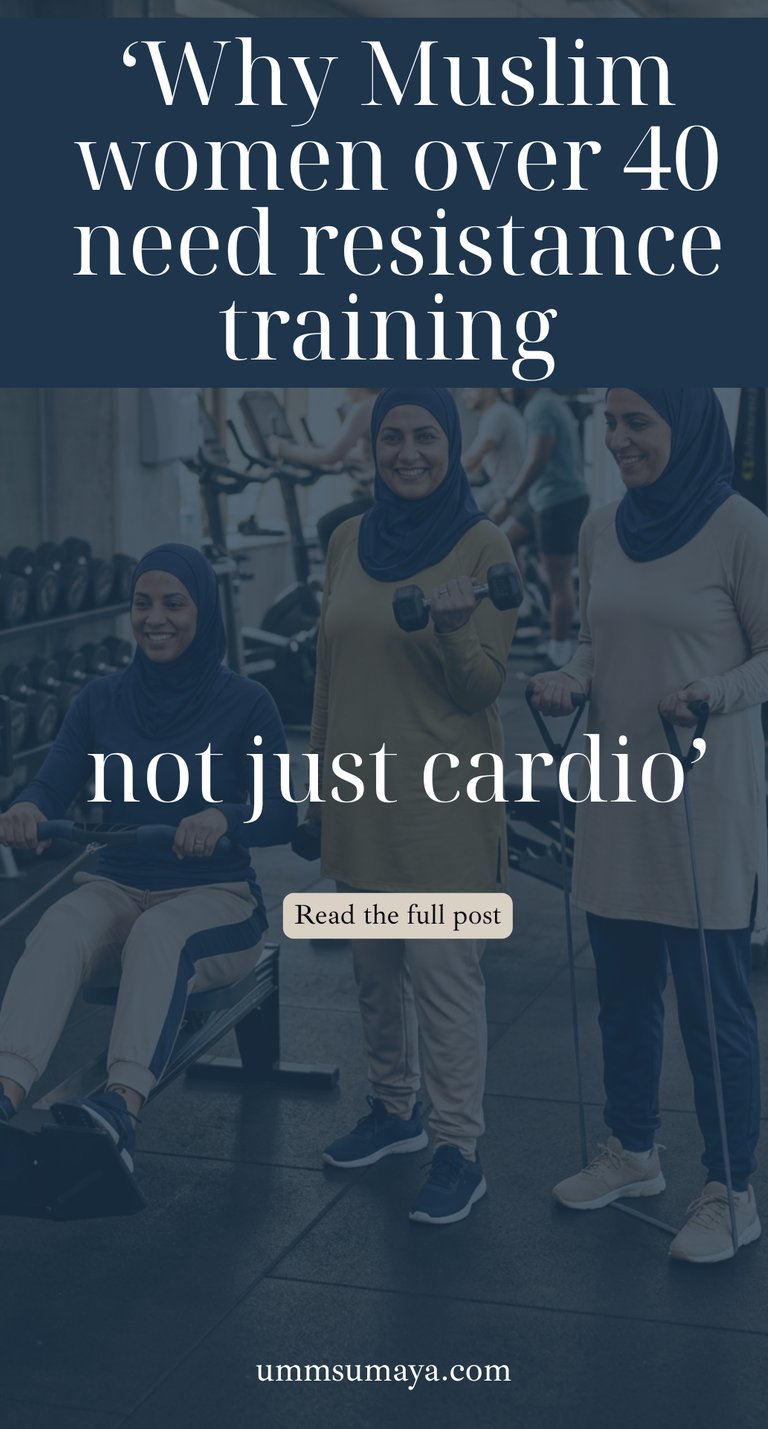
Many Muslim women over 40, particularly those who have always been significantly overweight, default to cardio when they think about exercise. Walking, swimming, aerobics. These are not wrong. But for women in midlife, they are not enough on their own.
Here is why resistance training deserves a specific place in your movement practice after 40.
Muscle Mass and Metabolism
From around the age of 30, women begin to lose muscle mass at a rate of approximately 3 to 8 percent per decade. This process accelerates after menopause. Less muscle mass means a slower metabolic rate, which means the body burns fewer calories at rest and becomes more prone to fat storage, particularly around the abdomen.
Resistance training is the only form of exercise that directly addresses this. It builds and preserves lean muscle mass, which keeps the metabolism functioning more effectively as the hormonal landscape changes.
Bone Density
Declining oestrogen during perimenopause accelerates bone loss. For women who are significantly overweight, this is compounded by the additional strain that excess weight places on the joints and skeleton over time. Resistance training is one of the most effective interventions for maintaining and improving bone density, more so than cardio exercise.
Insulin Sensitivity and Blood Sugar
Muscle tissue is one of the primary sites for glucose uptake. More muscle means better blood sugar regulation, which means more stable energy, fewer cravings, and less of the emotional eating that follows a blood sugar crash. For the sister whose relationship with food has been shaped by emotional patterns, this is not a peripheral benefit. It is central.
Strength, Mobility and Daily Life
For women who have carried significant weight for many years, the body starts to reflect that strain in the joints, the lower back, the knees, and the hips. Resistance training, done correctly and progressively, builds the muscular support around these joints, reduces pain, and improves the ease of daily movement. Getting up from the floor. Carrying shopping. Walking without pain. These things matter enormously and resistance training directly supports them.
Mental Health and Emotional Regulation
The research on resistance training and mental health is substantial. Regular strength training reduces symptoms of anxiety and depression, improves sleep quality, and supports emotional regulation. For women who have used food to manage difficult emotions, building an alternative outlet that produces genuine physiological benefits is not a small thing. The post-gym feeling, what I describe as a high after the session, is real and it is rooted in the release of endorphins, the reduction of cortisol, and the sense of having done something meaningful for yourself.
Where to Begin, Meeting Yourself Where You Are
This is the section I most want the sister at the beginning of her journey to read carefully. Because the fitness industry has a habit of presenting starting points that are only accessible to people who are already partway there. This is not that.
You meet yourself where you are. Fully. Without apology.
Start with an honest assessment of where your body is right now. Not where you want it to be. Where it is. How much can you walk comfortably? Can you stand for extended periods? Are there joints or areas that need to be worked around? This is not discouraging information. It is necessary information. You cannot build a plan that works without knowing your actual starting point.
If two thousand steps a day is where you are, make your next goal two thousand five hundred. Not ten thousand. The increment matters more than the destination in the beginning. Small, consistent increases build the evidence that change is possible, and the nafs needs that evidence before it will stop negotiating.
You do not need a gym to begin. A YouTube workout in your living room for ten or fifteen minutes is a legitimate starting point. There are excellent free resistance training videos for beginners, for larger bodies, and for women over 40. Use them.
When you are ready for the gym, do what I did. Go and look first. Take pictures of the machines. Google how to use them. Download a structured workout app. Go back with a plan. The unfamiliarity of the gym environment is one of the biggest barriers and the solution is simply information.
If you can access a women-only section, use it. If you cannot, know that the anxiety about being watched is almost always self-generated. Wear what covers you. Make your niyyah. Focus on your own mirror.
Three days a week of full body resistance training is what I work toward now. But I did not start there. You build to it. Consistency over time is what produces change, not intensity in the beginning.
The nafs al-ammara will tell you that you have left it too late. That your body is too far gone. That you have tried before and it did not work so there is no point trying again. This is the nafs doing what it always does, protecting its comfort at the cost of your wellbeing.
Do not negotiate with it. Begin anyway.
A Community Built Specifically for This Sister
I am building a Skool community - "Nafs & Nourishment is a community for Muslim women who are ready to explore their relationship with food through an Islamic lens. We're opening soon, join the waitlist to be the first through the door."
A Word for the Sister Who Has Been Here Before
If you have tried to get fit before and stopped, and tried again and stopped again — I need you to hear this.
The stopping was not a character flaw. It was the nafs leading. And the nafs leads when we have not yet understood what it is doing and why. When we have not yet connected the movement of our bodies to something larger than a goal weight or a dress size. When the intention has not yet been rooted in something that outlasts motivation.
I did not connect my fitness to my deen when I first started. I was doing it for the weight, for the body, for the metrics. And those things matter. But they are not enough to sustain the effort through the days when the nafs negotiates hardest.
What sustains it is the intention to honour an amanah. To care for what Allah gave you. To worship Him with a body that has been treated as the trust it actually is.
You are not too old. You are not too overweight. You are not too far into the pattern to change direction. The door is open. The body responds to care at every age and at every starting point.
Begin where you are. Begin with what you have. Begin with ten minutes if that is all you have.
But begin.
'Do not negotiate with your nafs. Begin anyway.'
والله أعلم — And Allah knows best
Do You Know Which Nafs Pattern Is Keeping You Stuck?
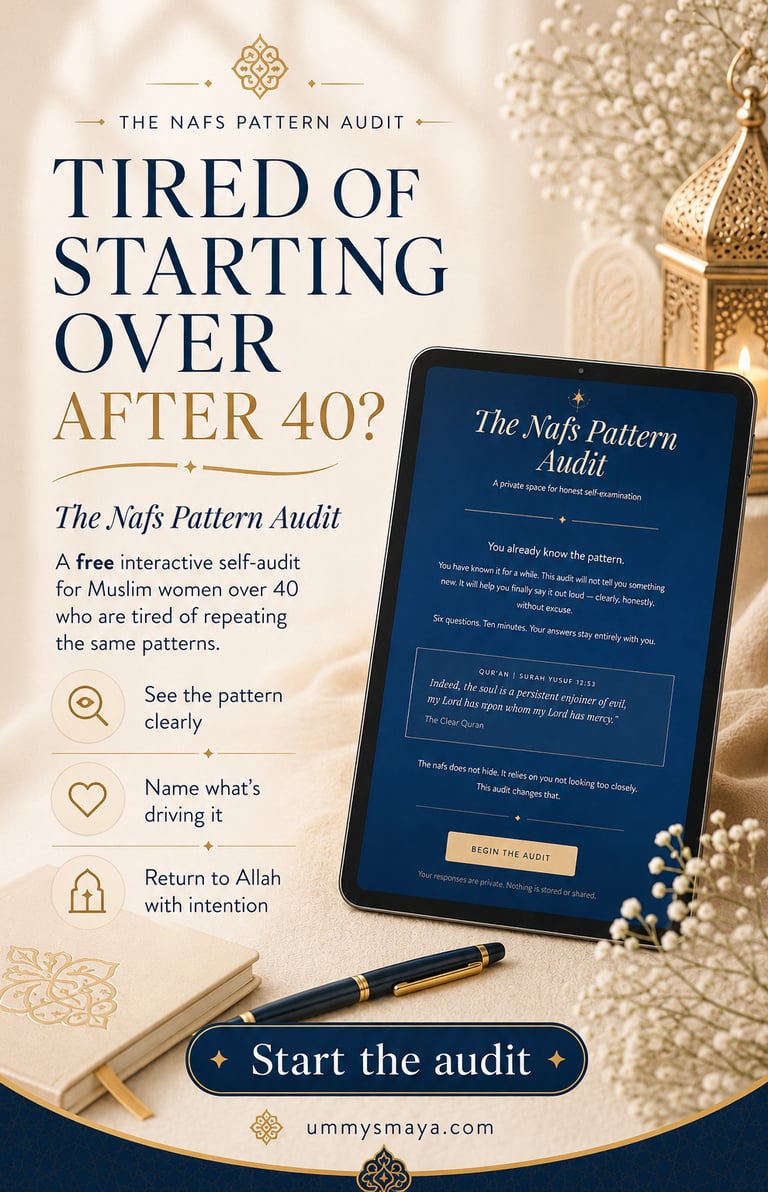
The Nafs Pattern Audit is a free resource that helps you identify exactly which pattern of the nafs is operating beneath your relationship with food, movement, and the habits you keep breaking. Not generic self-reflection. A focused, deen-rooted audit that shows you where the nafs is leading and where to begin taking back the reins.
The Imaan Reset System — Free Download
A free guide helping Muslim women over 40 understand the nafs, recognise the patterns keeping them stuck, and begin returning to conscious choice in body, heart, and deen.
Download it free. Begin where you are.
About Umm Sumaya
Asalam Alaykum dear sister, my name is Umm Sumaya, I helps Muslim women over 40 understand the role of the nafs in emotional eating, self-sabotage, and the patterns that keep them stuck so they can return to conscious choice, restore barakah, and reconnect with Allah. My work draws on Islamic psychology, lived experience, and a deep understanding of the challenges facing Muslim women in midlife.