
When the Nafs Uses Your Emotions Against You, Understanding Emotional Triggers Through an Islamic Lens
For most of my adult life I thought my problem was food. What I did not understand was that the food was never the issue. It was the solution my nafs had found for something else entirely. And no meal plan, no amount of discipline, and no fresh start on Monday can address what the nafs is actually doing.
Umm Sumaya
7/20/202612 min read
I want to describe a feeling to you.
It is a feeling of urgency. Of haste. Like something needs to happen right now. It is uncomfortable, not dangerous, not dramatic, just deeply, persistently uncomfortable. And in the middle of that discomfort, there is a pull. Toward the kitchen. Toward the biscuits. Toward whatever it is that has historically made that feeling go away, even for a moment.
You know this feeling. I know you do. Because I lived in it for most of my adult life without understanding what it actually was.
I thought it was hunger. I thought it was weakness. I thought it was just me, the way I was wired, the battle I was always going to have, the thing I would never fully get on top of. And that belief, that this is just who I am, kept me stuck for longer than I care to admit.
What I did not know, what nobody had ever explained to me, is that what I was experiencing in those moments was not me. It was my nafs. The commanding self. The part of me that had learned, over years and decades, to reach for food whenever something uncomfortable arose. And once I understood that, everything began to shift.
This post is about that shift. About what is actually happening when the emotional trigger fires and the pull toward food begins. About what the nafs is doing in that moment, why it does it, and what becomes possible when you finally understand the difference between the nafs pulling and you choosing.
It Was Never Really About the Food
For a long time I thought my problem was food. I thought if I could just find the right eating plan, the right level of discipline, the right environment, I could get control of it. And I would. For a while. And then something would happen, I would feel bored, or stressed, or that low-level restless feeling would settle in, and I would find myself eating again in a way that had nothing to do with hunger.
The confusion this created in me was real. Because on one hand I desperately wanted to lose weight and eat in a way that honoured my body. And on the other hand there was this deep, persistent pull in the opposite direction. It felt like wanting two things at the same time and being unable to choose between them. And when the pull won, the guilt that followed was enormous.
What I understand now is that the food was never the issue. The food was the solution my nafs had found for something else entirely.
The nafs al-ammara, the commanding self, seeks immediate relief from discomfort. That is its nature. And whatever it learns will provide that relief, it returns to again and again. For me, food had become the primary source of that relief. Boredom arrived and the nafs moved toward food. Procrastination set in and the nafs offered food as a way to delay. Stress or discomfort arose and the nafs reached for whatever it had learned would make that feeling temporarily manageable.
The food was not the problem. The nafs using food to escape the feeling was the problem. And those are two very different things that require two very different responses.
إِنَّ النَّفْسَ لَأَمَّارَةٌ بِالسُّوءِ"Indeed, the soul is a persistent enjoiner of evil." — Quran 12:53
This ayah does not say the nafs is evil. It says the nafs persistently commands toward what harms. That is precisely what is happening in the emotional eating moment. The nafs is not malicious. It is persistent. And it is commanding toward what it has learned will bring immediate relief, regardless of the long-term cost.
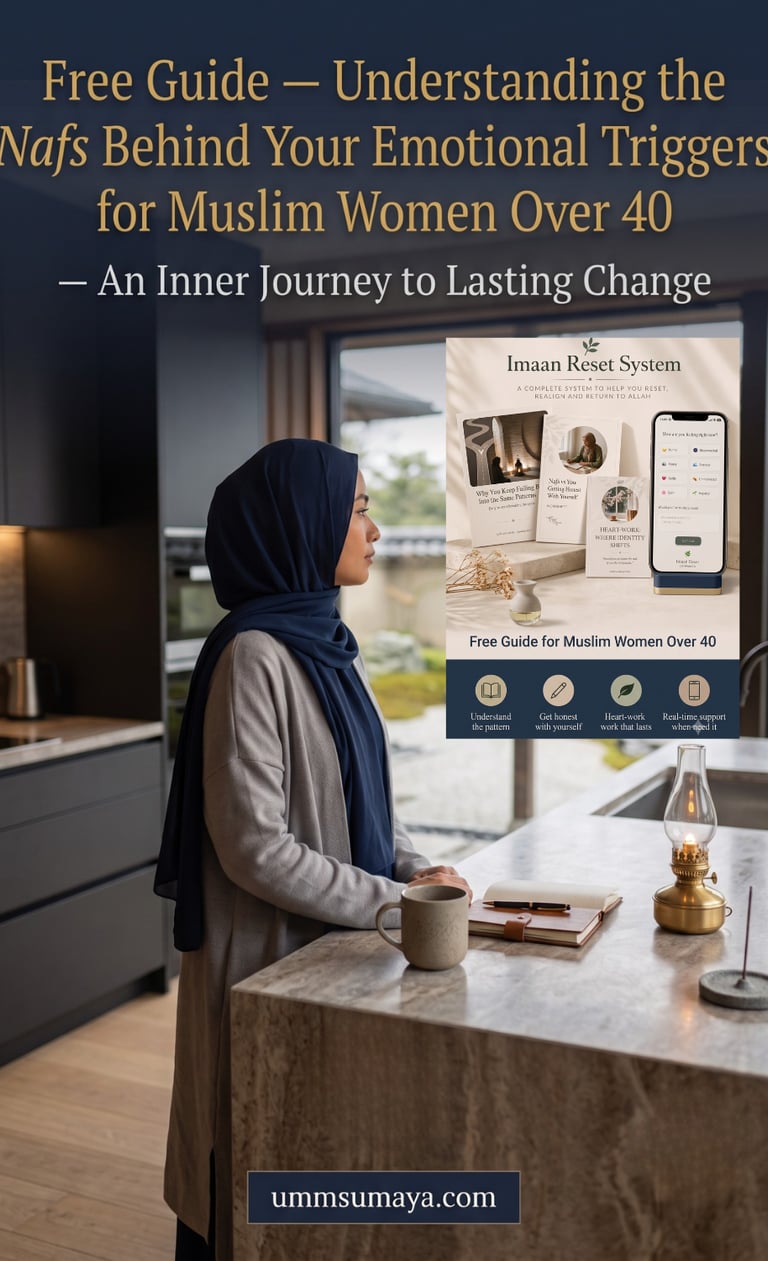
Is this the pattern you have been living in?
The Imaan Reset System is a free guide for Muslim women over 40 who want to understand the role of the nafs in their relationship with food and begin the return to conscious choice rooted in the deen.
Download it free before you read on.
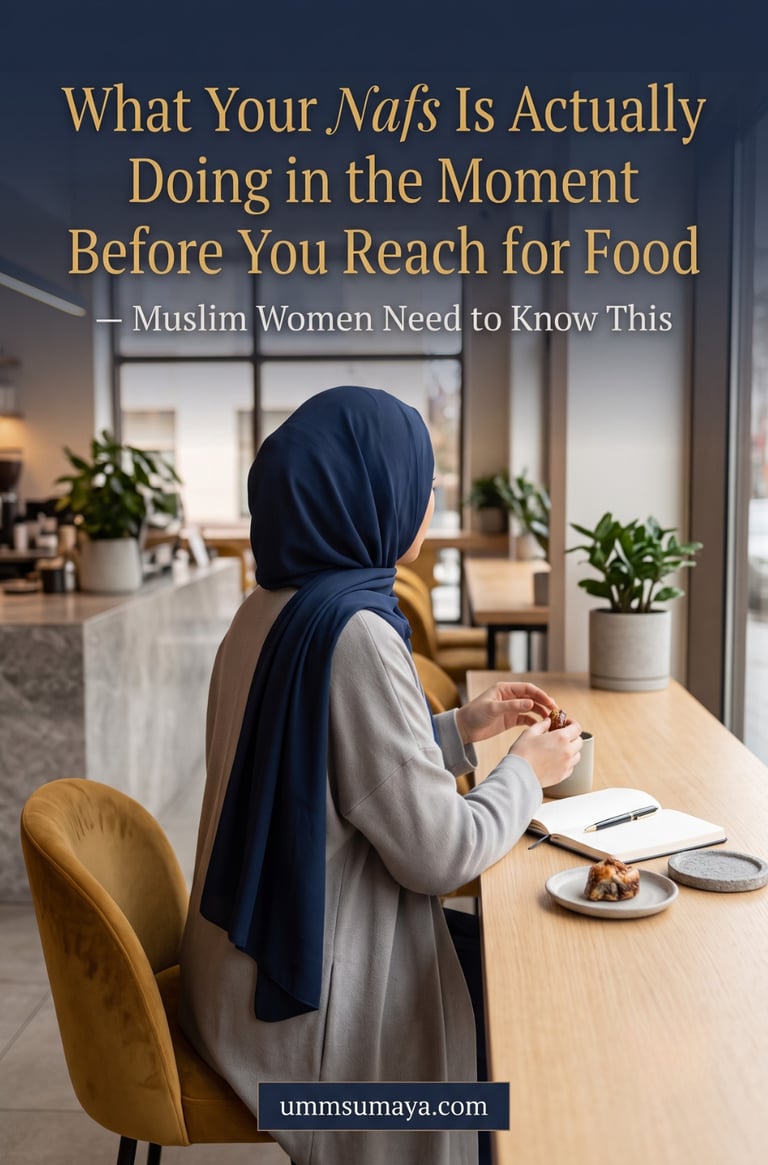
What the Nafs Is Actually Doing in That Moment
Here is something that took me a long time to understand and that I want you to sit with.
The nafs al-ammara is not your enemy. It developed these patterns to protect you.
I know that might sound strange. But think about it. At some point in your life, in a moment of discomfort or pain or boredom or overwhelm, food brought relief. Real relief, even if temporary. The nafs learned from that. It filed it away. And every time a similar feeling arose after that, it retrieved the pattern and offered it as the solution. The nafs was, in its own limited way, trying to help.
The problem is not the intention behind the pattern. The problem is that the pattern does not actually solve what it promises to solve. The boredom is still there after the eating. The procrastination is still there. The stress has not gone anywhere. And now there is guilt on top of everything else, which itself becomes the next trigger.
Ibn al-Qayyim wrote at length about the diseases of the heart and the nafs, the ways in which the self, when left untrained and unexamined, reaches for what soothes rather than what heals. The comfort-seeking of the nafs al-ammara is not a sign of weakness. It is the default state of the untrained self. Every human being has this. The question is whether you understand what is happening well enough to work with it.
What the Nafs Seeks in the Emotional Eating Moment
Relief from discomfort. Whatever the feeling is, boredom, restlessness, anxiety, loneliness, the pressure of a decision that needs making, the nafs wants it gone, and it wants it gone now.
Escape from the tug of war. When you are on a health journey and a craving arises, there is a back-and-forth in your mind between what you want to do and what the nafs is pulling you toward. The nafs does not want to resolve that tension in your favour. It wants to end the tension by giving in. And giving in does end it, temporarily. That is what the nafs is offering.
Freedom from the feeling, not the food itself. This was the realisation that changed everything for me. What I wanted was freedom from the craving, from the urgency, from the discomfort of the pull. I mistakenly believed that eating the food would give me that freedom. What it actually gave me was freedom from the battle, for a moment, until the guilt arrived and the cycle began again.
Understanding this is not just intellectually interesting. It is practically transformative. Because once you see that the nafs is not chasing the food but chasing relief from the feeling, you can begin to ask a different question in that moment. Not can I resist this craving but what is this feeling actually asking for?
The Moment Everything Changed, When I Understood the Separation
Something happened in my life that turned everything upside down. I am not going to go into the details here but what I will say is that it was the kind of disruption that forces you inward. You cannot keep looking outward when the ground beneath you has shifted. So I turned inward, and that began a journey of personal development, of learning about the nafs, of taking my deen more seriously in ways that I had not before.
And in that season, something became clear to me that I had never seen before.
Food had become my master. Not Allah. Food. Or more precisely, my nafs had elevated food to a position it was never supposed to occupy, a source of comfort, freedom, relief, and escape that belonged only to Allah. And I had been a slave to it without knowing it. Without ever having been given the language or the framework to see what was happening.
The moment I understood the nafs, its levels, its patterns, the way the nafs al-ammara operates beneath conscious thought, was the moment I experienced what I can only describe as a separation. A degree of distance between me and the urge. For the first time, I could see the nafs pulling rather than simply being pulled. And that gap, however small it was in the beginning, was everything.
"The strong person is not the one who overcomes others by force. The strong person is the one who controls himself when angry." — Sahih al-Bukhari and Sahih Muslim
This hadith is about anger but the principle extends across every impulse of the nafs. Strength is not the absence of the urge. Strength is the presence of a pause between the urge and the response. That pause is where conscious choice lives. That pause is what the nafs al-ammara does not want you to have. And cultivating that pause became my work.
I call it my superpower now. The pause. It sounds simple. It is not always easy. But it is available to every single one of us, in every single moment, regardless of how long the pattern has been running.
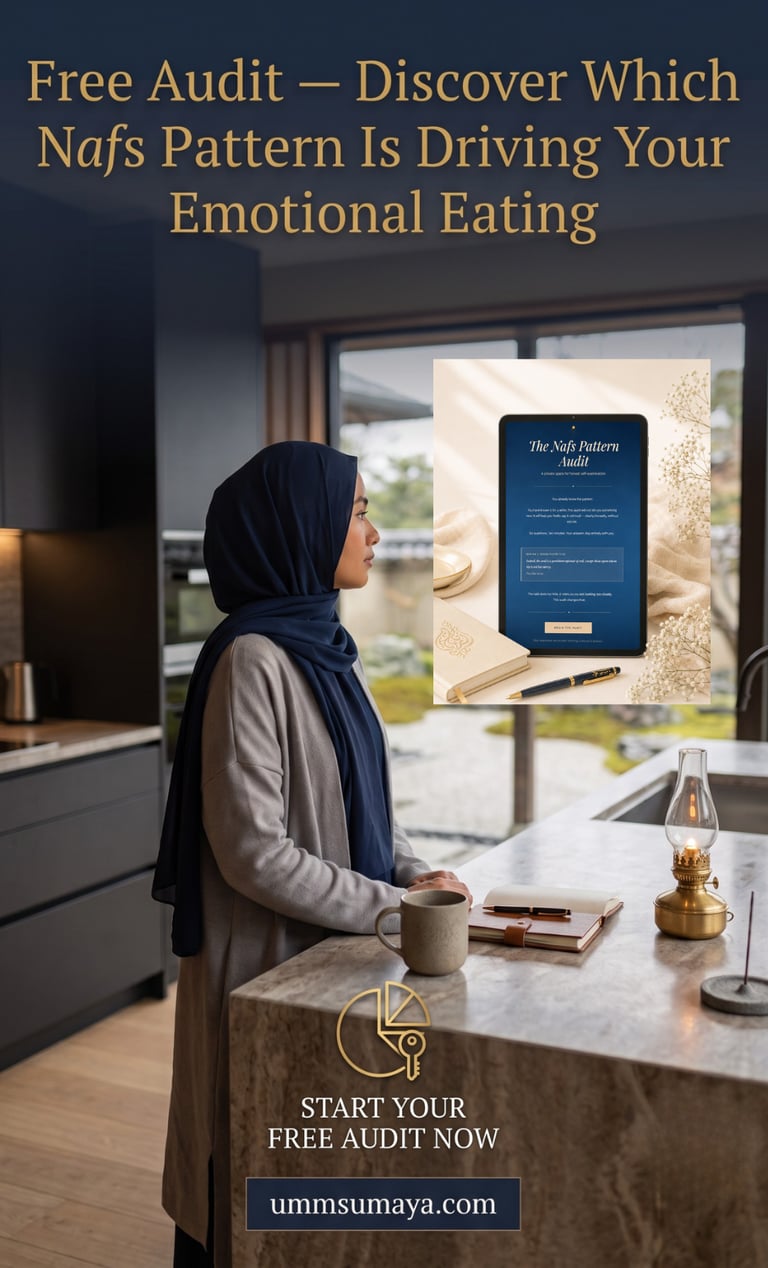
Do you know which nafs pattern is operating beneath your emotional triggers?
The Nafs Pattern Audit is a free resource that helps you identify exactly which pattern of the nafs is driving your relationship with food and emotional triggers, rooted entirely in Islamic understanding, not generic self-help.
Download it free and begin seeing your patterns clearly.
What Changes When You Understand the Nafs Framework
I want to be honest with you here. Understanding the nafs did not make the cravings disappear. It did not instantly rewire years of learned patterns. There were still moments where I gave in, where the urgency won, where the food happened before the pause could.
But something had fundamentally changed. Even in the moments where I still gave in, I was watching. I was aware of exactly what was happening. I could narrate it in real time. I could see the nafs moving, see the story it was telling me, see the moment the urgency peaked and the pull intensified. And that awareness, even without immediate behavioural change, began to loosen the grip.
Because the nafs al-ammara lives in the unconscious. It lives in the automatic. The moment you bring it into the light of awareness, its power begins to reduce. Not all at once. Gradually. But the direction changes.
What Practically Changed in the Moment of the Trigger
The pause became possible. Before understanding the nafs, the gap between the trigger and the response was almost zero. The urgency was the action. After understanding, I began to insert a moment, however brief, between the two. Just enough to observe what was happening.
I started asking different questions. Instead of why can I not just control myself, I started asking what is my nafs seeking right now? What is the actual discomfort beneath this urge? Is it boredom? Avoidance? Stress? The question changed everything because it redirected my attention from the food to the feeling.
I found Islamic alternatives for the moment of urgency. If the nafs is seeking relief, I began offering it real relief rather than false relief. Two rakahs of salah when the pull was strong. Dhikr in the moment of urgency. Sitting with the discomfort long enough to notice that it passes on its own. These are not techniques borrowed from wellness culture. They are the tools the deen already gave us.
I stopped seeing myself as someone with no self-control and started seeing myself as someone whose nafs had been leading for a long time. That is a completely different identity. One is a character flaw. The other is a pattern that can be changed.
The nafs can be trained. This was the piece of knowledge that gave me back something I had lost, hope. Not the hope of perfection. Not the hope of never feeling the pull again. But the hope that the pattern is not permanent, that it was learned and can therefore be unlearned, that every time I chose the pause I was doing something real and meaningful regardless of whether anyone else could see it.
قَدْ أَفْلَحَ مَن زَكَّاهَا"Successful is the one who purifies it." — Quran 91:9
Purification is not a one-time event. It is the work of a lifetime. And every pause, every moment of awareness, every time you choose to observe rather than obey the nafs, that is purification in progress.
For the Sister in the Middle of the Trigger Right Now
If you are reading this and you are in that moment, the trigger has fired, the urgency is rising, the pull toward food is real, I want to speak directly to you.
What you are feeling right now is not you. It is your nafs trying to protect what it has always known. It is responding to something uncomfortable by offering you the fastest route to relief it has in its repertoire. It is not punishing you. It is not proving that you are weak or broken or beyond help. It is doing what it has been trained to do.
And here is what I want you to understand about that discomfort underneath the urge. The nafs wants you to believe that if you do not follow it, the discomfort will become unbearable. It will not. The urgency feels like it will build forever if you do not act on it. It will not. Every single craving, every single urge, has a peak and then it passes. You do not have to believe me. You just have to pause long enough to find out.
Pause. That is all. Just pause.
Not forever. Not with a perfectly formed plan. Just a moment of not yet. In that moment, notice what is actually happening. What is the feeling beneath the pull? What is your nafs trying to escape or avoid or soothe? You do not have to solve it. You just have to see it.
And if you give in anyway, that is not the end of anything. The nafs al-lawwama, the self that knows better and still falls, is not a state of failure. It is a state of awareness. And awareness is the beginning of every real change.
For the sister who has never connected any of this to her nafs, who still believes this is simply a discipline problem or a character flaw, I want you to hear this clearly.
This is not you. This is a part of you that can be trained.
The same way these patterns were learned, they can be unlearned. Not through brute force. Not through shame. Through understanding, through the pause, through returning again and again to the awareness that you are not your impulses and that between the nafs pulling and you responding, there is a choice.
That choice is always available. Even now. Even after everything.
A Final Word, On Switching Masters
There was a period in my life where food was my master. Not in a dramatic or conscious way. But in the quiet, daily, relentless way that the nafs establishes these things. Every time the discomfort arose and the food answered it, every time the urgency won and the relief followed, the nafs was reinforcing its position as the one in charge.
What I wanted, what I made dua for, genuinely and repeatedly, was to switch that. To remove food from the position it had been given in my heart and return that position to Allah. To go from feeling like a slave to my urges to being a willing, intentional servant of my Lord.
That journey is ongoing. I will not tell you otherwise. But the direction has changed. And the change in direction began not with a diet or a fitness plan but with a single piece of understanding: that what I had been calling me was actually my nafs. And my nafs, unlike me, can be trained.
Do not negotiate with your nafs. Understand it. Observe it. And choose differently, one pause at a time.
والله أعلم — And Allah knows best.
The Imaan Reset System, Free Download
A free guide helping Muslim women over 40 understand the nafs, recognise the emotional patterns keeping them stuck, and begin returning to conscious choice in body, heart, and deen.
Download it free. Begin where you are.
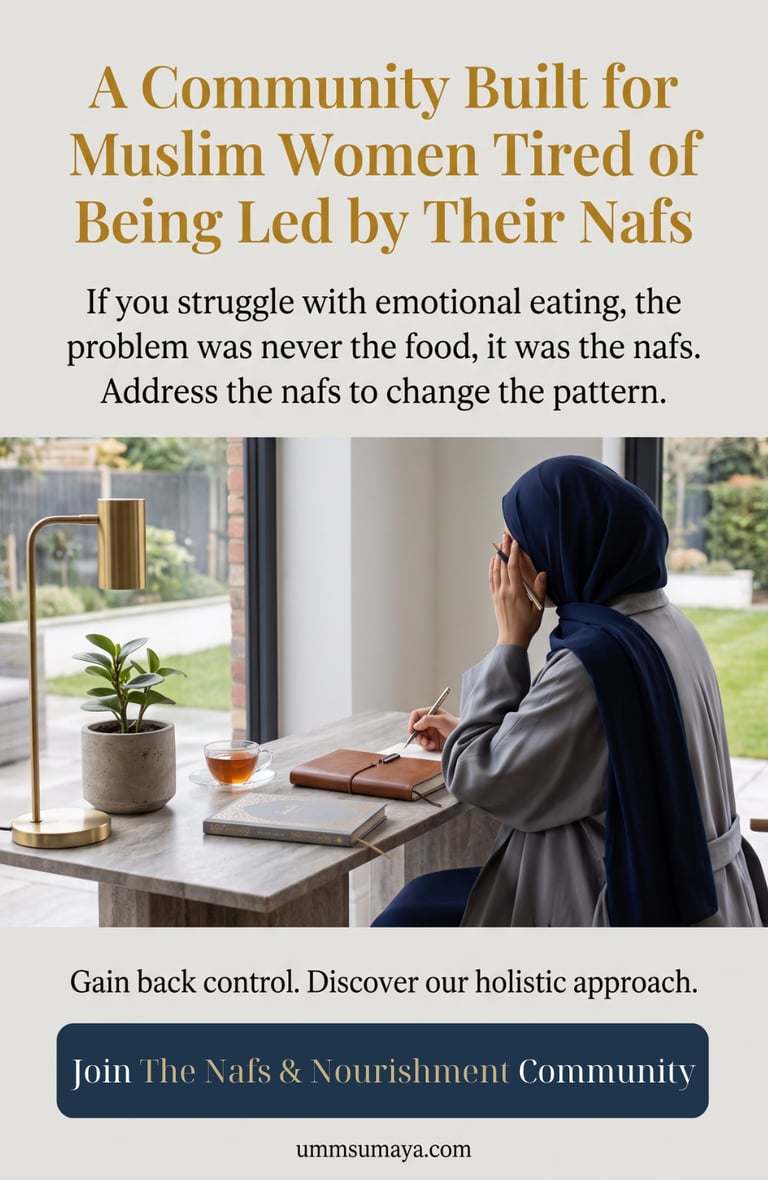
A Community Built for the Sister Who Is Ready to Switch Masters
I am building a Skool community specifically for Muslim women over 40 who are significantly overweight, who have an unhealthy relationship with food, and who are ready to stop feeling like a slave to their urges and begin the return to Allah as their true source of comfort and relief.
This community is being built for her. If that is you, I want you to know it is coming and it has been built with your specific experience in mind.
link to Nafs & Nourishment. (waitlist)
About Umm Sumaya
Asalam Alaykum my name is Umm Sumaya I helps Muslim women over 40 understand the role of the nafs in emotional eating, self-sabotage, and the patterns that keep them stuck so they can return to conscious choice, restore barakah, and reconnect with Allah. my work draws on Islamic psychology, lived experience, and a deep understanding of the challenges facing Muslim women in midlife.